
01
Context
The problem hiding in plain sight
Millions of creators and small business owners in Tier 2 and Tier 3 cities depend entirely on Instagram and WhatsApp to run their businesses. They cannot afford a website. They do not have technical expertise. And the tools built for them — Linktree, Beacons, and their alternatives — were never actually built for them.
Existing link-in-bio tools were static, generic, and built around aesthetics rather than outcomes. A real estate agent needed to showcase listings. A local service provider needed bookings. A small business owner needed sales. None of them needed a prettier list of links. The gap between what these tools offered and what these users actually needed was the entire design opportunity.

02
Research
Listening before assuming
Research revealed four consistent breakdowns across the target user groups — social media influencers, small business owners, real estate agents, and local service providers. Each one became a direct design requirement.
Existing tools were built for aesthetics, not conversions
Link-in-bio platforms prioritised visual customisation over business outcomes. There were no features designed to highlight CTAs, guide user attention, or improve click-through rates. Users were decorating pages that weren't actually working for them.
Non-technical users couldn't unlock tool potential
Even when features existed, the editing interfaces were too complex for users without design or technical backgrounds. The effort required to produce a high-quality page was a significant barrier — and most users settled for the default template and never touched it again.
No business-oriented content structures existed
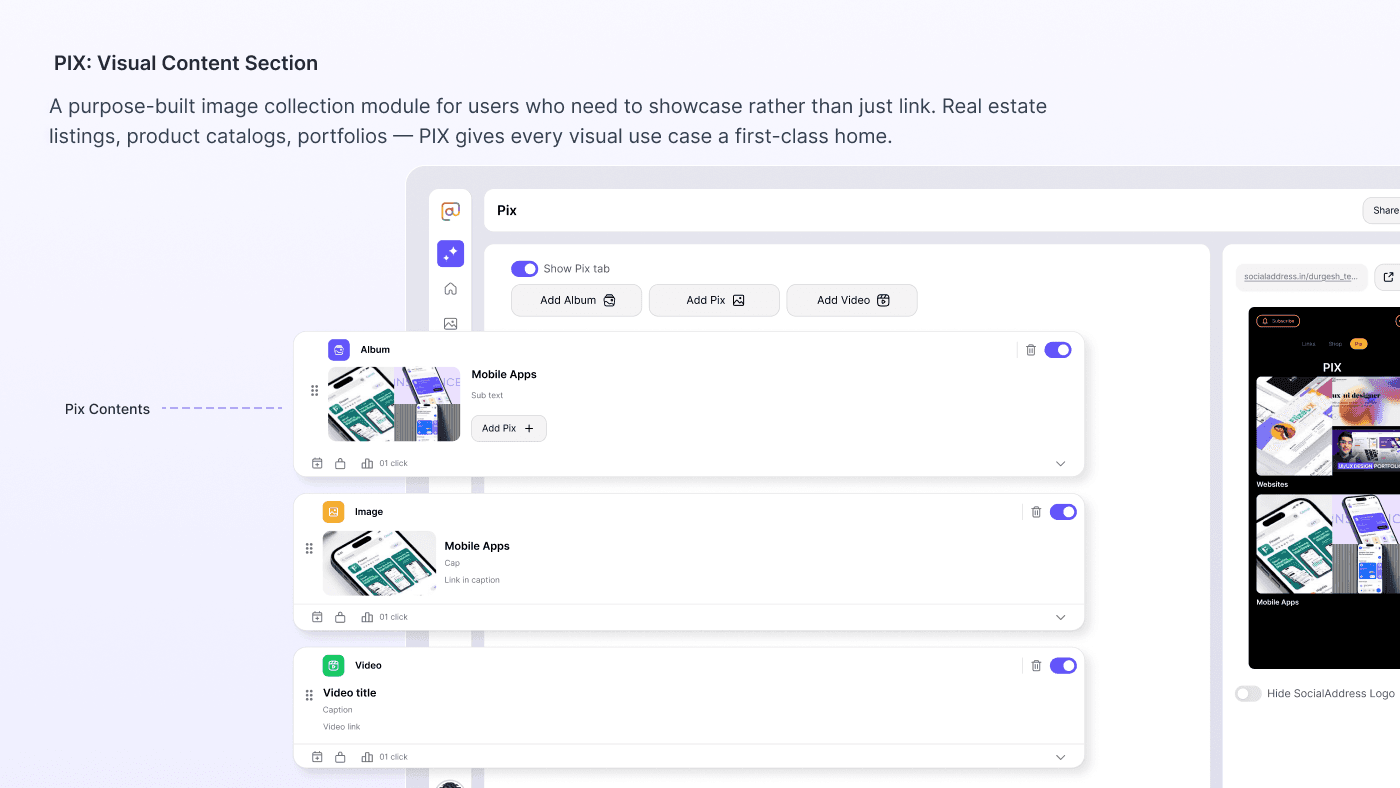
Real estate agents needed image galleries. Product sellers needed visual catalogs. Portfolio creators needed structured media sections. None of the available tools offered purpose-built content types for business use cases — only generic link blocks.
Analytics were absent or incomprehensible
The users who most needed data — small business owners making decisions about where to invest their time — either had no analytics access at all, or were presented with raw data they couldn't interpret or act on.
03
Define
Sharpening the problem statement
How Might We
How might we give non-technical creators and small business owners a tool that builds, optimises, and updates their digital presence automatically — so that they can focus on running their business, not managing a page?
Two primary user profiles shaped every design decision: The Creator (influencer or content producer, needs engagement-first layouts, fast content updates, and a page that grows with their audience) and The Local Business Owner (real estate agent, service provider, or product seller, needs conversion-focused layouts, visual product showcasing, and simple analytics they can actually use). Both were entirely underserved by the current generation of link-in-bio tools.